Look far ahead, not at your feet
Fixing your gaze three to five steps ahead lets you anticipate the line rather than reacting step by step.
 TRAILBOARD.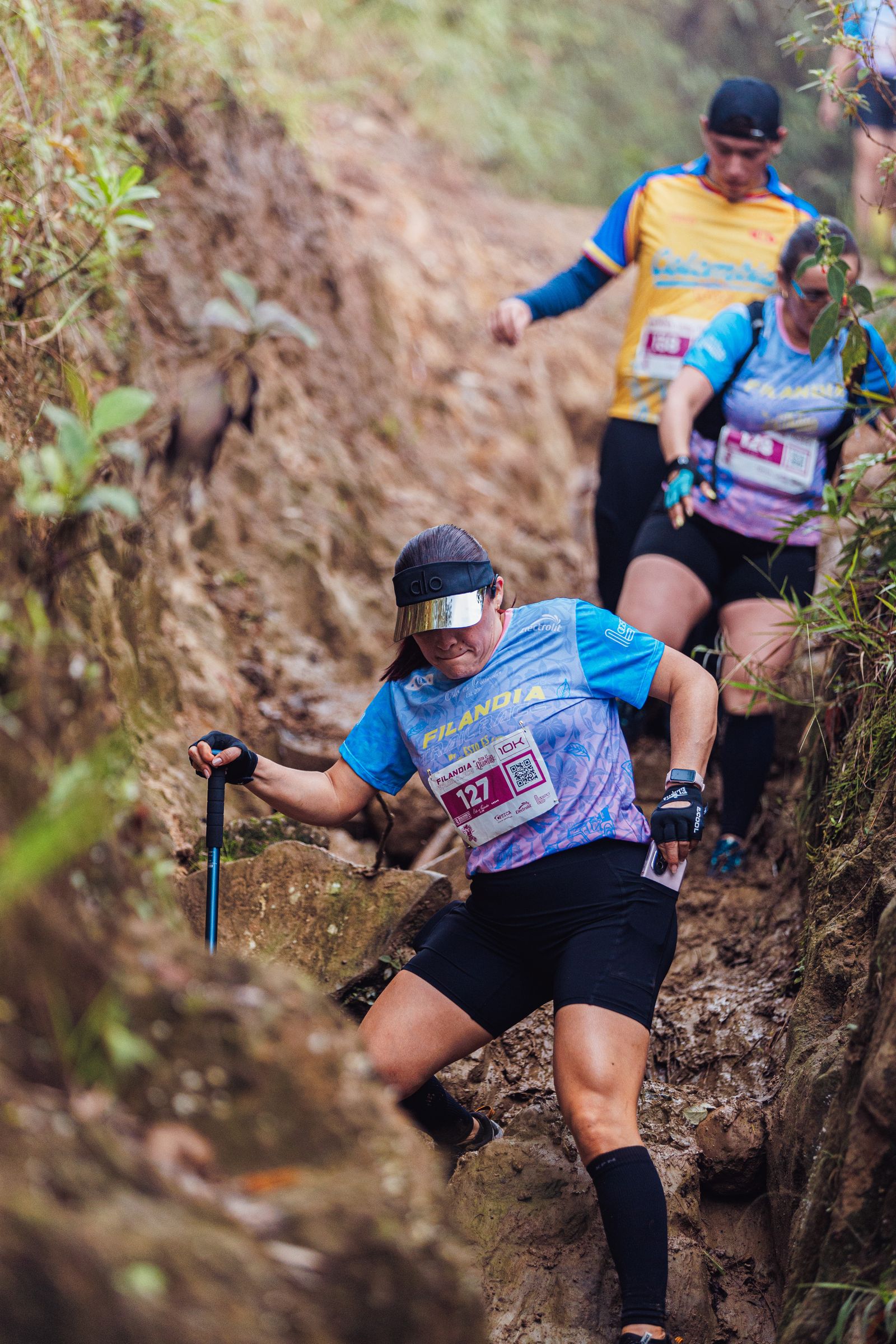
Downhill technique
Line choice, footwork and pole use: the technique that really makes the difference on technical descents — beyond strength training.
Edition 1.0 · August 2026Before speed
Most downhill falls come from a line decided too late, not from a lack of raw speed.
Fixing your gaze three to five steps ahead lets you anticipate the line rather than reacting step by step.
A technical trail often offers several possible lines: the most direct one is not always the safest or the fastest.
Spotting the next obstacle while negotiating the current one avoids being caught out by the terrain at the last moment.
A line chosen in advance makes every foothold predictable — high speed without a chosen line only makes falls faster.
Contact with the ground
Footwork suited to the terrain reduces the risk of slipping and the repeated joint wear of downhill running.
On dirt or sand, a flat foot strike distributes weight better than landing on the forefoot.
Shorter, more frequent strides limit time spent off-balance on a loose rock or root.
A locked knee transmits impact straight to the joint; a bent knee absorbs part of the shock.
One more contact point
Many trail runners fold their poles away downhill — yet that is exactly where they add the most stability on unstable terrain.
A pole planted slightly ahead offers a balance point before the foot lands.
The pole corrects balance, it does not brake your whole body weight — leaning too hard tires shoulders and wrists.
On a hands-on scramble or very cluttered section, folded or stowed poles avoid getting caught.
Three terrains, three techniques
The same fast, flowing descent on a smooth trail becomes dangerous on scree — technique must change with the terrain, not stay identical everywhere.
Favor rocks that look anchored over patches of loose stones that roll underfoot.
Speed never compensates for ground moving under your feet — slowing down here is faster than a fall.
Short, frequent steps limit the sliding distance if a rock gives way.
Without scaring yourself
Downhill confidence is built through progressive exposure, not by aiming for speed on your first technical outing.
Downhill technique is built through repetition at a controlled speed — never by accelerating on terrain you cannot yet read well.
Method
Sources support general principles about downhill running and injury risk. They do not replace supervised progressive learning if needed.
Review of eccentric downhill demands and the value of progressive technical exposure.
↗Maps musculoskeletal injuries reported in ultra-endurance, some of them linked to falls and technical downhill terrain.
↗Chargement…
Member space
Comments
Share your experience, ask a question or add a useful insight for the community.