
Temperature, rain, wind, sun, humidity, altitude and expected changes.
Trail equipment masterclass
Choose equipment as a system, not a shopping list
The right kit is neither the most expensive nor the lightest. It protects against the actual scenario, stays accessible while moving and has already been tested in comparable conditions.
Scientific revision1.2
Technical flat-lay of a trail equipment system with three clothing layers, vest, flasks, poles, shoes, lighting and traction devices.
Weather sets protection→Effort creates heat and moisture→Terrain sets the cost of an error→Autonomy sets what must be carried
Guiding principle
Start with the risk, not the shop shelf
Two 80K races can require opposite systems. Ask five questions before adding any object.
Time without shelter, ridges, night, snow, technicality and escape options.
Running, steep walking, stops, intensity and heat production.
Aid-station spacing, confirmed water, personal self-sufficiency and, when dated rules allow it, crew support, designated support stations and drop bags.
What has been worn wet, handled with gloves and used while fatigued.
Equipment is validated only when its function, limit and use scenario are known. An authorized drop bag is a controlled remote inventory: authorization, tested contents, access, collection and a plan if the bag is absent.
Chapter 1
The three layers: manage a flow, do not stack three jackets
The system moves moisture, retains only the needed heat and blocks the elements. A layer may be worn, stored or replaced as effort changes.
Kit for this situation
Rain and wind
Wet ridge and faster cooling when pace drops.01
Base layer
WearMove moisture away from skin and limit friction.
Why this choice?
Check Close fit without compression, tolerated seams and tested drying.
Limit It cannot prevent saturation or cooling during a stop.
02
Insulating layer
PackProvide insulation when heat production is no longer enough.
Why this choice?
Check Insulation matched to intensity, compressible and accessible.
Limit Too warm while moving, it increases sweat and may become a wet liability.
03
Outer shell
WearReduce wind heat loss and limit water ingress.
Why this choice?
Check Stable hood, real ventilation, mobility and glove-friendly closures.
Limit A membrane does not remove condensation; sweat can wet the inside.
Vent uphill, close before the ridge, add insulation when output falls.
Waiting until cold before adding protection.
The most important layer may be the one that stays dry in the pack until the critical moment.
Chapter 2
Dress the zones that can change the day
The torso is not the whole thermal system. Extremities, friction zones and wet garments often decide what happens next.
Head and neck
Quickly modulate heat, sun, rain and wind.
Cap, neck tube and hood stay stable without restricting vision or hearing.Hands
Keep dexterity for eating, zips and phone use.
Test wet gloves, overmitts and every critical closure.Legs
Balance protection, range of motion and heat loss.
Shorts, tights or overtrousers do not compress after hours.Feet
Manage moisture, pressure, debris and swelling.
Socks, shoes and gaiters are tested as one system.Skin
Limit repeated friction at chest, armpits, groin, waist and feet.
Identify personal zones and respond to early signals.Dry reserve
Restore insulation after saturation or a stop.
The layer remains genuinely dry in waterproof storage.Wetness + wind + reduced intensity is a new scenario even when air temperature is unchanged.
In heat, more fabric or a cooling claim does not replace acclimation, pacing and cooling.
Chapter 3
Shoes, socks and traction: safety starts with the surface
No shoe category universally prevents injury. Durable fit, retention, comfort and terrain-specific grip must work together.
Volume
Allow swelling without letting the foot slide on descents.
Retention
Secure heel and midfoot without pressure points.
Outsole
Match lug geometry and rubber to rock, mud, grass, snow and runnable sections.
Protection
Match toe guard, stability and stiffness to actual technicality.
History
Prefer a shoe-sock pairing already worn long in similar conditions.
Three families that are not interchangeable
Trail shoe
Outsole lugs
Dirt, mud, rock and trail depending on pattern and rubber.
Prevent blisters without promising a recipe
- Test the shoe-sock pair wet and over long duration.
- Remove debris and folds immediately.
- Treat a hot spot before a blister forms.
- Document personal success instead of changing several variables on race day.
- Never discover a shoe, insole or sock on race day.
- Weather and surface outrank model marketing.
- Fit, remove and store traction with cold hands before the event.
Chapter 4
Terrain and decisions: measure the consequence of an error
A runnable trail, an exposed slope and a wet or snowy crossing demand different trade-offs. Equipment does not make terrain safe: it must remain matched to what can actually happen.
01Runnable trail
Readable ground, frequent escape options and continuous progress.
DecisionPrioritize comfort, access and low unnecessary load.
02Exposed slope
A fall may be serious, footholds are precise and margin is reduced.
DecisionAdapt precision, grip and protection; slow down or turn around when margin disappears.
03Wet or snowy
Variable grip, cooling and sometimes reduced visibility.
DecisionPlan compatible traction, a dry protection layer and a defined turnaround point.
Readable ground, frequent escape options and continuous progress.
ConsequencePrioritize comfort, access and low unnecessary load.
Do not keep heavy kit without a distinct function.A fall may be serious, footholds are precise and margin is reduced.
ConsequenceAdapt precision, grip and protection; slow down or turn around when margin disappears.
A shoe or pole does not replace skill or judgment.Variable grip, cooling and sometimes reduced visibility.
ConsequencePlan compatible traction, a dry protection layer and a defined turnaround point.
When the device is no longer enough, the right equipment is turning back.Good equipment does not beat terrain that has become incompatible; it helps recognize the change early enough to adapt or turn around.
Chapter 5
Vest, pack and flasks: make equipment available without carrying the problem
Nominal volume says nothing about fit, access or behaviour under load. The best system disappears from attention while running.
Immediate access
H₂O Water reserveCHO Food reserveTEL Charged phoneCUP Personal cupSOS WhistleL1 Headlamp
Prevents delaying a simple action until the next aid station.
Stable zone
Reduces bounce, rotation and mechanical noise.
Protected reserve
ISO Survival blanketPL Waterproof hooded jacket+ Elastic bandageBAT Spare powerTH Dry insulating layer
Preserves safety function after hours of rain.
5–12 L
Classic ultra simulation: base kit remains accessible with margin between aid stations.
Simulated contentsSupported ultra, variable weather and several hours of autonomy.
Educational simulation: check the dated race rules and activated weather kits.
Water reserve2 × 500 ml + 500 ml
Common baseFood reserve
Common baseCharged phone
Common basePersonal cup
Common baseWhistle
Common baseSurvival blanket
Common baseWaterproof hooded jacket
Common baseElastic bandage
Common baseHeadlamp
Scenario-dependentSpare power
Scenario-dependentDry insulating layer
Scenario-dependent+ Visible level, quick access and refill, left-right balance.
− Bounce or chest pressure depending on fit.
Run full, half-full and nearly empty.Unused weight is paid for all day; inaccessible equipment is paid for at the wrong moment.
Chapter 6
Poles: a locomotion tool to prepare
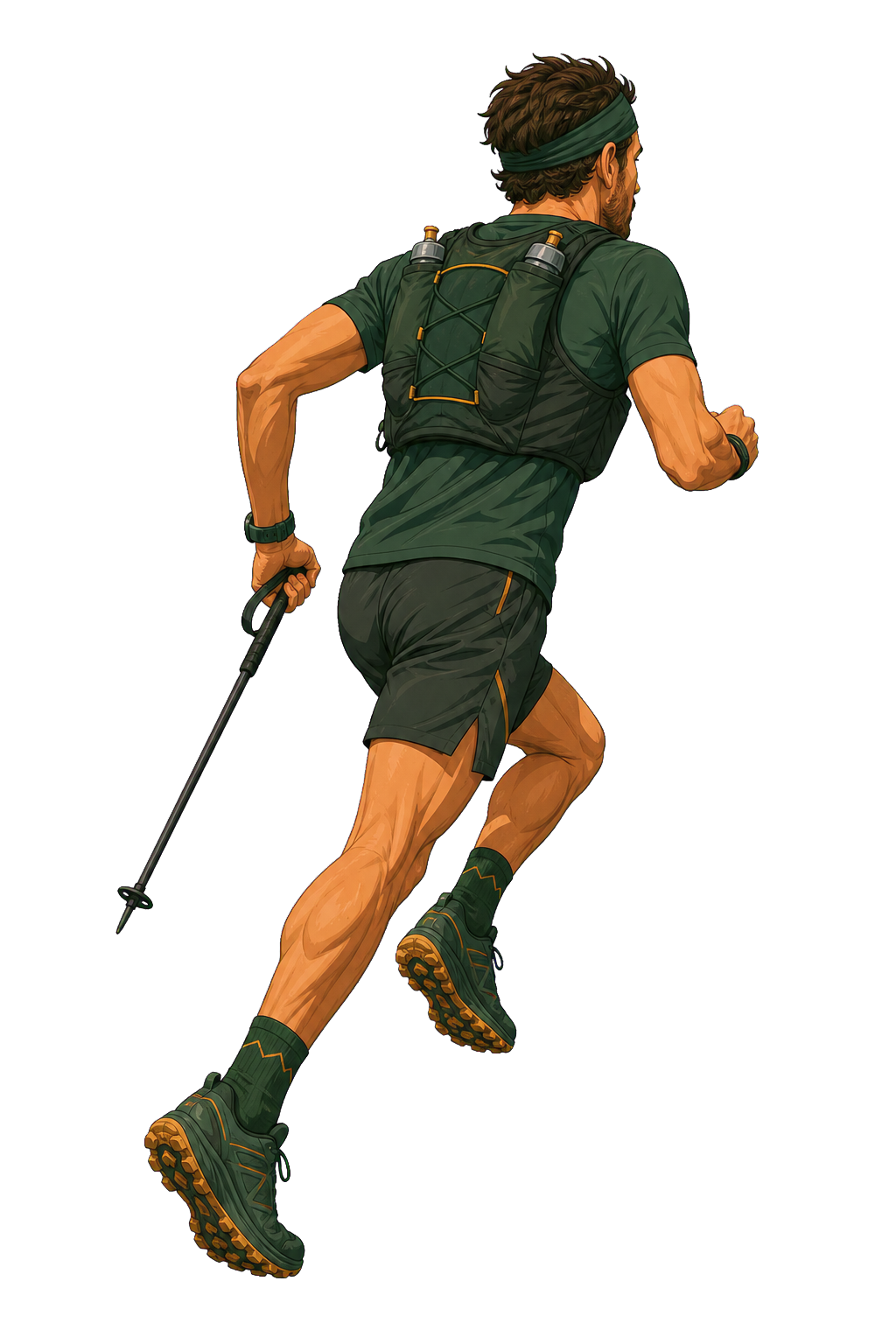
On a long, mountainous ultra, poles can become central equipment: they help distribute effort during long climbs and walking sections. Their value still depends on terrain, technique, race rules and training.
Climb: push
Runnable: stow
Downhill: coordinate
On an 80 km race with 3,500 m of ascent, they often become a very relevant choice: they can support a dynamic hike and spread work across legs, trunk and upper limbs.
Two poles allow symmetrical pushing and stable coordination. When an athlete chooses poles, the pair is the reference format; one pole remains occasional.
On a regular climb, keep the tips generally behind the body; push through the strap and wrist, into the forearm and shoulder, while matching the opposite leg.
A quiver or storage pocket must fit the exact vest. An accessory made for a Salomon pack is not automatically suited to a Decathlon or another brand.
Train the movement
- Set length for body and grade, then keep the setup stable.
- On a regular climb, use the diagonal pattern: right pole with left leg, left pole with right leg. Also test double-poling where appropriate.
- Push through the strap and wrist, engaging forearm and shoulder instead of only gripping the handle.
- Use a dynamic hike: plant, load, push, then move without crossing in front of the feet.
- Deploy, fold and stow both poles with the loaded pack, without losing rhythm.
Choose the whole system
- Folding poles: compact and quick to stow, but test stiffness and locking.
- Telescopic poles: adjustable, often longer when packed.
- Aluminium or carbon: compare weight, stiffness, resilience and cost, not material alone.
- Removable straps: useful to free the hand quickly if the mechanism is familiar.
- Quiver or pack pockets: verify attachment points, diameter, packed length and bounce.
Do not improvise
- take them without checking race rules and pickup/drop zones;
- use a branded quiver on another vest without confirmed compatibility;
- run with one pole by default or hold poles on runnable ground;
- make race day the first test of length, straps or storage.
On a mountainous ultra, poles are a system: two tools, one technique, compatible storage and validation before race day.
Chapter 7
Night, power and mandatory kit: prepare for failure
A lamp works until battery, cold, setting or handling becomes the limiting factor. Safety needs a degraded mode.
Accessible without unpackingOne failure cannot disable all
Beam and runtime tested at actual pace.
Independent source immediately accessible.Known charged battery protected from water and cold.
Measured margin, not only a manufacturer figure.Charged, on power saving or airplane mode when possible, with map and track downloaded offline.
Know how to send your location and carry spare power when justified.Reliable water identified between points; waterproof gloves and a dry layer accessible.
Do not confuse a planned water point with confirmed potable water.Whistle accessible and the race-specific signaling process understood.
Local instructions and rescue guidance take priority over a generic rule.Markers, map and track used as complementary systems.
Return to the last certain point instead of guessing forward.Blanket, whistle and dry layer compliant with rules.
Reachable without emptying the pack in rain.Planned runtime = cautious night duration + margin for cold, high power, navigation error and delay.
A generic list never replaces the dated rulebook, minimum dimensions, standards, inspections and weather decisions of the organizer.
Chapter 8
Four profiles for reasoning, never copying
These profiles show how the system changes. They are not universal lists.
Supported temperate trail
Stable day, frequent aid and many escape options.
- Core
- tested baserequired protectioncompact carrywater between points
- Add
- Light weather margin based on exposure.
- Remove
- Duplicates without distinct functions.
- Decisive test
- Access while moving and fit when nearly empty.
Ultra with night
Temperature swing, fatigue and hours of darkness.
- Core
- modular layersmain lampindependent backupstable loaded pack
- Add
- Dry reserve and power margin.
- Remove
- Untested or inaccessible night gear.
- Decisive test
- Complete night outing with layer changes.
Hot exposed race
Radiation, little shade and limited cooling.
- Core
- appropriate coveragesun protectionreal water capacitycooling access
- Add
- Validated cooling method.
- Remove
- Unnecessary layers blocking heat exchange.
- Decisive test
- Drinking access, wet-textile comfort and refill.
Cold, rain or snow
Wind, wetness, lower pace and slow rescue.
- Core
- managed basedry insulationouter protectionprotected extremities
- Add
- Traction and reserve based on official terrain.
- Remove
- Incompatible “just in case” clothing.
- Decisive test
- Wet handling, gloves and simulated stop.
Do not lighten by deleting a safety function; lighten by removing duplication, poor format and inaccessibility.
Chapter 9
A race rehearsal turns an object into equipment
A purchased product is not yet a capability. It must be integrated into movement, weather and race gestures.
Full load
Run with start weight and full flasks.
No increasing bounce, pressure, noise or friction.Timed access
Retrieve layer, food, phone and emergency item without emptying the pack.
Every critical item is found first time.Wet and cold
Handle zips, gloves, hood, traction and lamp with cold wet hands.
Gestures remain possible without removing essential protection.Aid station
Refill, discard, repack and leave as in the event.
Items retain fixed places and water level is known.Degraded mode
Simulate failed main lamp, delay, rain or unusable flask.
The backup plan is independent and immediate.Final inventory
Check dated rules, current forecast, wear and charge.
Every object has a named function and nothing mandatory is missing.Nothing new on race day includes storage, settings, batteries, layers and gestures, not only shoes.
Bibliography
What is demonstrated and what still needs testing
Trail equipment evidence is thinner than marketing. This guide therefore separates studies, consensus, standards and official rules.
- ConsensusCastellani et al. / ACSM (2021)
ACSM Expert Consensus Statement: Injury Prevention and Exercise Performance during Cold-Weather Exercise. Curr Sports Med Rep. doi:10.1249/JSR.0000000000000907.
Current framework for cold-related risks, prevention and performance.↗ - Position standCastellani et al. / ACSM (2006)
Prevention of Cold Injuries During Exercise. Med Sci Sports Exerc. doi:10.1249/01.mss.0000241641.75101.64.
Supports individualized clothing based on cold, wind, wetness and the person.↗ - Scientific reviewDi Domenico et al. (2022)
The Role of Sports Clothing in Thermoregulation, Comfort, and Performance During Exercise in the Heat. Sports Med Open. doi:10.1186/s40798-022-00449-4.
Shows that fabric, fit and coverage affect comfort and heat exchange, with no miracle material.↗ - ConsensusRacinais et al. (2015)
Consensus Recommendations on Training and Competing in the Heat. Br J Sports Med. doi:10.1136/bjsports-2015-094915.
Frames acclimation, exposure and cooling strategies in heat.↗ - Experimental studyGiovanelli et al. (2019)
Do Poles Save Energy During Steep Uphill Walking? Eur J Appl Physiol. doi:10.1007/s00421-019-04145-2.
Measures small energy savings but a larger reduction in perceived effort on steep grades.↗ - Experimental studyGiovanelli et al. (2023)
Do Poles Really Save the Legs During Uphill Pole Walking at Different Intensities? Eur J Appl Physiol. doi:10.1007/s00421-023-05254-9.
Shows modest reductions in foot force and a performance effect in the tested conditions.↗ - Experimental studyScheer et al. (2020)
The Optimal Weight Carriage System for Runners: Handheld Bottles, Waist Belts, and Backpacks. Front Physiol.
Compares three ways to carry 1 kg with no clear physiological difference over one hour.↗ - Observational studyRochat et al. (2019)
An Enactive Approach to Appropriation in the Instrumented Activity of Trail Running. Cogn Process. doi:10.1007/s10339-019-00921-2.
Shows that bounce, access and pack appropriation emerge from runner-terrain-equipment interaction.↗ - Scientific reviewRelph et al. / Cochrane (2022)
Running Shoes for Preventing Lower Limb Running Injuries in Adults. Cochrane Database Syst Rev. doi:10.1002/14651858.CD013368.pub2.
Finds weak evidence that shoe categories prevent running injury.↗ - Scientific reviewWorthing et al. (2017)
Prevention of Friction Blisters in Outdoor Pursuits: A Systematic Review. Wilderness Environ Med. doi:10.1016/j.wem.2017.03.007.
Highlights scarce robust evidence and possible value of paper tape in some settings.↗ - Scientific reviewScheer et al. (2021)
Epidemiology of Injury and Illness Among Trail Runners: A Systematic Review. Sports Med. doi:10.1007/s40279-020-01418-1.
Identifies foot problems, blisters, abrasions and sprains among common trail issues.↗ - Safety standardUIAA Safety Commission
UIAA Safety Standards, including Standard 153 for mountaineering crampons.
Separates standardized mountaineering equipment, including true crampons, from light traction aids.↗ - Official regulationsWorld Mountain and Trail Running Championships
Competition manual: mandatory and authorised trail-race equipment remains a race-specific official decision.
Shows that mandatory kit depends on race rules, weather, distance and the technical delegate.↗ - Official regulationsUTMB® Mont-Blanc (2026)
Race regulations: basic mandatory equipment, weather-activated additional kit, permanent carriage and immediate accessibility for checks.
Separates basic gear from weather-activated items, all accessible for inspection.↗ - Official regulationsUltra-Trail Australia by UTMB® (2026)
Mandatory gear tables by race format, including water capacity, lighting, weather protection, food reserve and dry storage.
Provides a detailed official example of kit varying with distance and exposure.↗
Member space
Comments
Share your experience, ask a question or add a useful insight for the community.