Current reference
Recalculate products actually consumed and check that the value holds across several sessions.
 TRAILBOARD.
Gut training guide
A g/h target describes a strategy. It proves neither what you actually consume nor what your intestine absorbs. The aim is to learn from comparable tests without automatically climbing towards the highest value.
Scientific revision 1.0 · 31 July 2026Understand before testing
These three pieces of information answer different questions. Mixing them creates false precision.
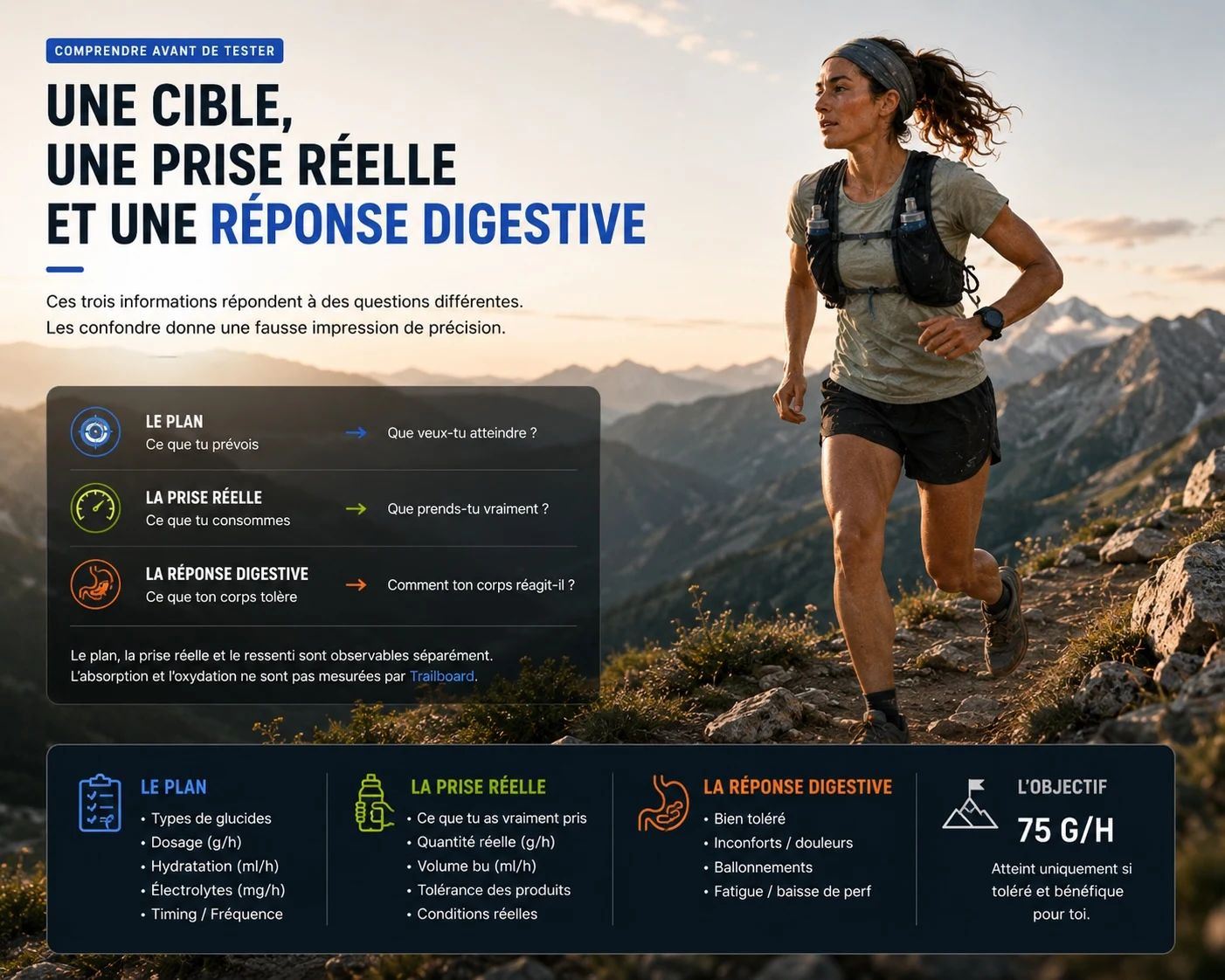
Confidence rises when the plan, actual intake and field feedback are all known.
What the plan targets. A range calculated from duration, intensity and context. It remains a starting assumption.
What was really consumed. The amount actually swallowed, calculated from the real duration and products used.
Not measured by Trailboard. They cannot be inferred from the plan, product count or absence of symptoms.
What was repeated without functional failure. A value tolerated during comparable efforts. It does not directly measure intestinal absorption.
Each step remains a hypothesis until repeated in a relevant context.
Already repeated
Step to test
Controlled products and context
Maintain, retest or adjust
Observe · decide · retest
Tolerating 75 g/h does not make 75 g/h compulsory on race day. The selected target may remain lower.
A difficult session is not rewarded by raising the target. The next action follows the actual impact.
No functional impact
Mild or variable discomfort
Intake impossible or marked symptoms
The absence of symptoms is useful tolerance information. It is not a direct measure of carbohydrate absorption or oxidation.
Observe, test, decide
Controlled trials show that the gastrointestinal system can adapt. They do not prove that one protocol, duration or target suits every trail runner.
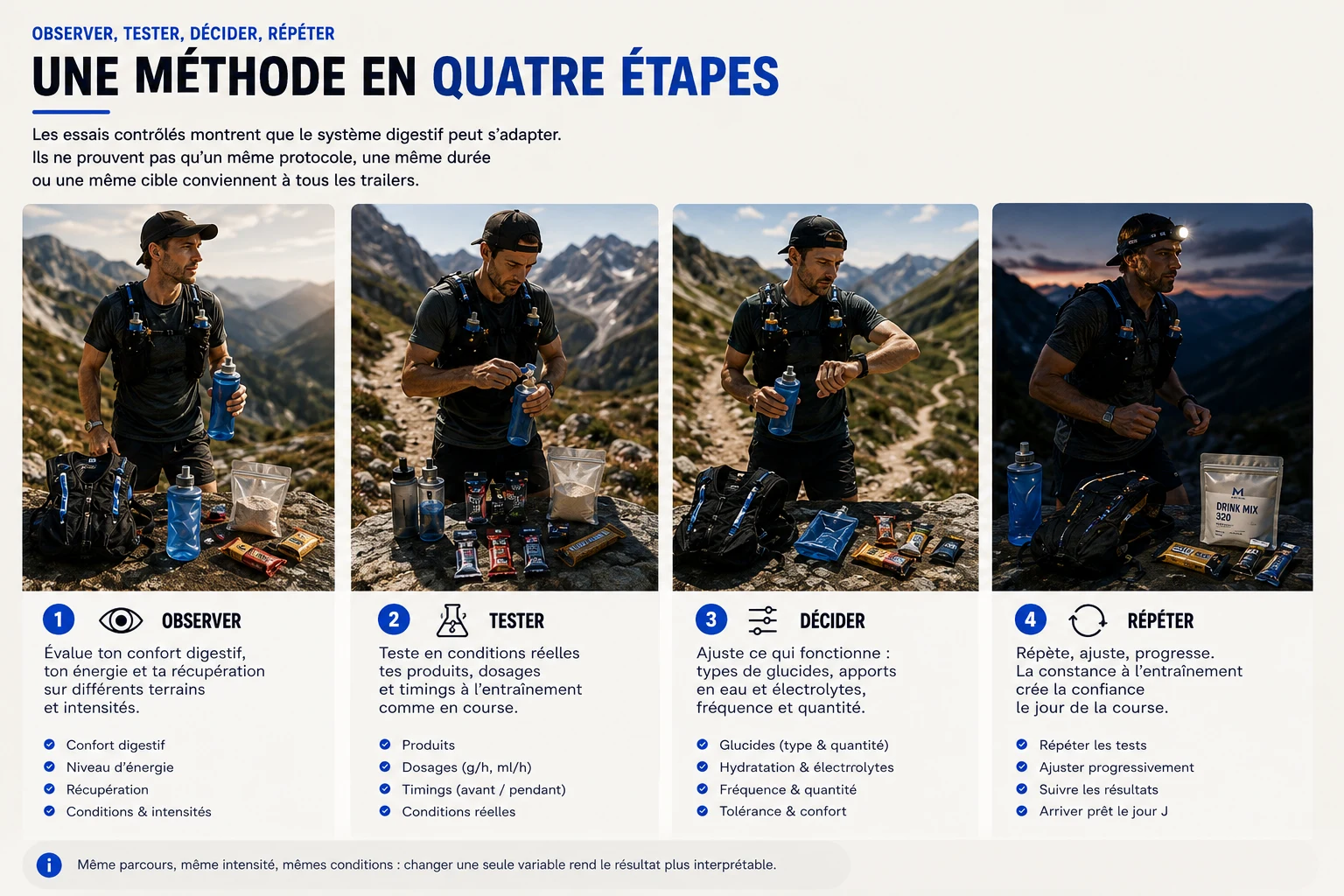
First reproduce that strategy with the same products, including sweet and savoury formats, and calculate carbohydrates and sodium actually consumed, not just planned intake.
One success is a signal, not a confirmed capacity.Change one main element. Otherwise a better or worse result remains difficult to explain.
Step size is an individual practical choice, not a consensus prescription.Repeat the step before calling it tested. Record heat, elevation, pace, drink volume and products.
Controlled studies support gut adaptability, but their small samples cannot promise an individual outcome.Test carried products, portions, climbs, descents, heat or darkness that resemble race day.
A value becomes a race candidate after repeated use without limiting symptoms in a relevant context.Do not increase after an ambiguous test. After a missed or poorly tolerated intake, record actual intake, sip fluid if it remains tolerated, then choose a previously tested lower-sweetness, diluted or different-texture option. Resume small frequent portions before reassessing the step; do not try to catch up with one large intake.
Illustration, not protocol
This example shows a decision logic. It sets neither a mandatory number of sessions nor a universal calendar.
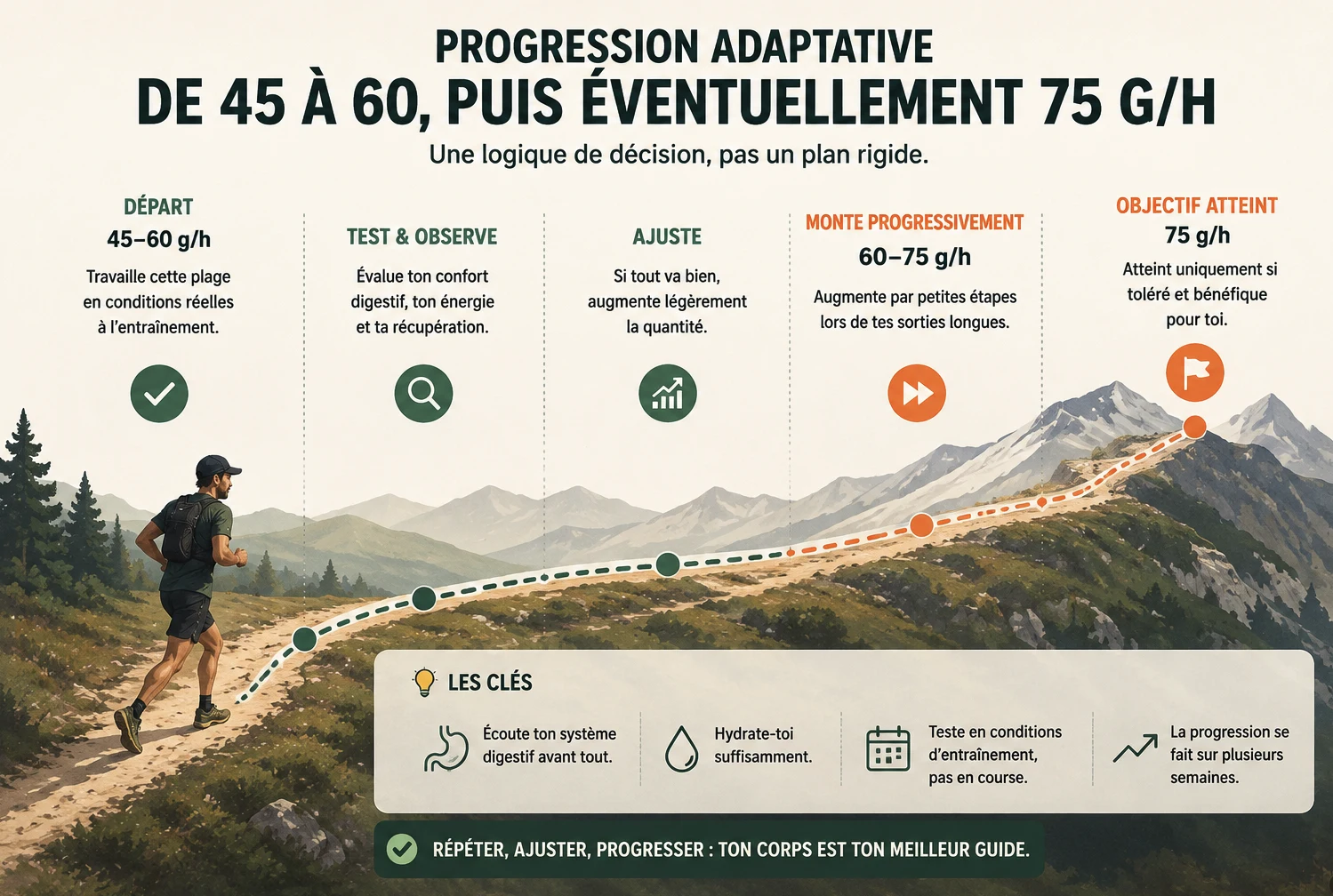
Assumption: 45 g/h has already been genuinely consumed and well tolerated during a long session.
Recalculate products actually consumed and check that the value holds across several sessions.
Test with one main change, then repeat in a comparable session before changing the target.
Consider only if the race justifies it, 60 g/h is stable and the carbohydrate mix and products are prepared.
Race-required capacity and athlete-tested capacity must remain visible separately. Trailboard can propose closing the gap, never manufacture validation.
Mountain specificity
These tactics are mainly field practice. They must be tested with the same products and constraints as the race.
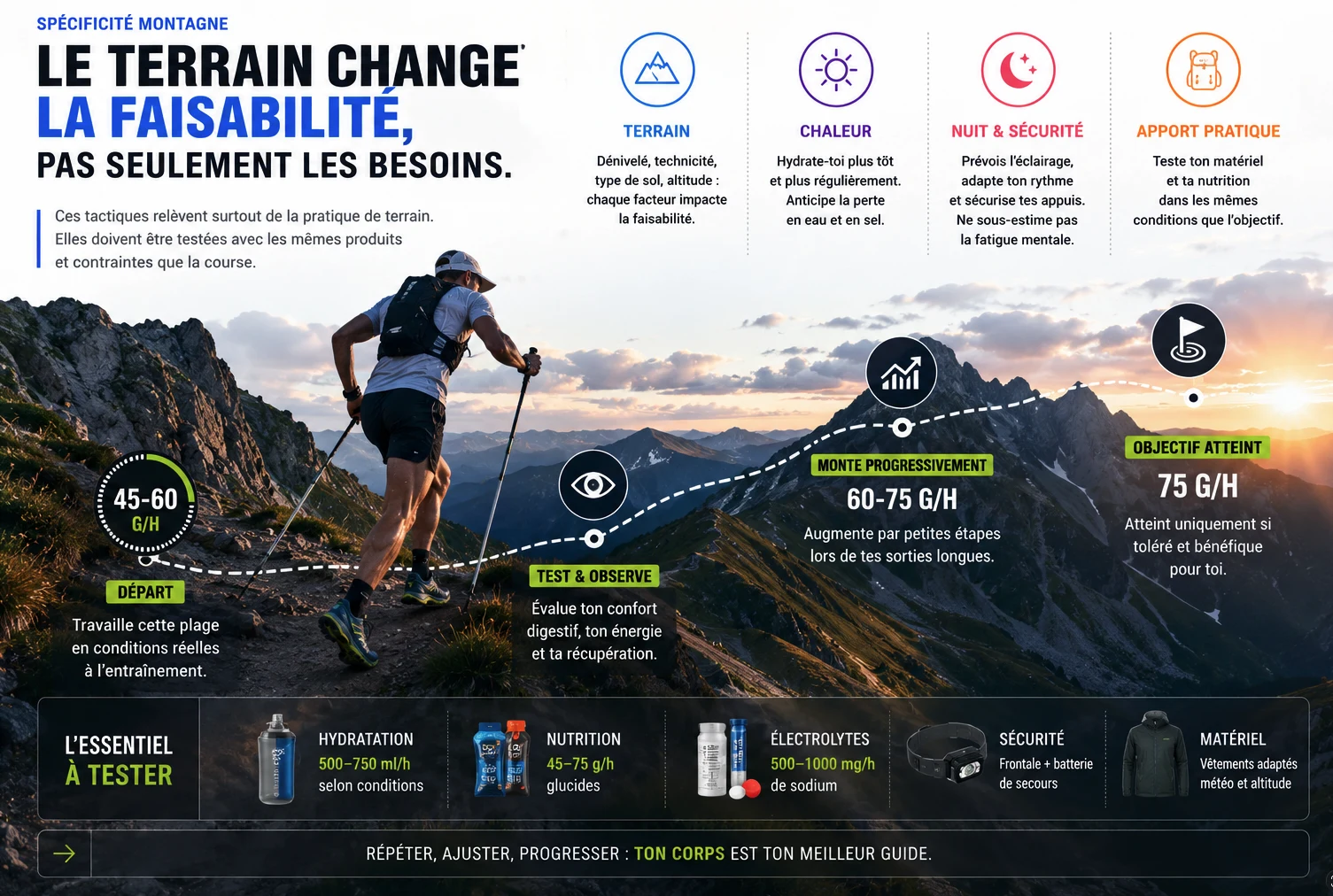
Intensity and breathing can reduce comfort and make chewing difficult.
Compare intake before the climb with small intakes during a steady climb.Chewing, opening packaging or drinking may become impractical.
Test format and timing without turning the descent into a laboratory.Heat stress and dehydration may intensify gastrointestinal disturbance.
Progressively reproduce conditions and track carbohydrate, fluid and symptoms together.Fatigue, cold and monotony can make a theoretical plan unusable.
Test sweet and savoury portions, several textures and a simple fallback; count the carbohydrates and sodium actually taken.Turn feedback into useful data
A short, consistent log is more useful than a perfect report completed only once.
Trailboard
Repeated vomiting, significant diarrhoea, marked pain, blood in stool, faintness, inability to drink or recurrent symptoms justify stopping escalation and seeking medical or sports-dietitian advice.
Scientific references
Consensus statements frame intake. Trials and reviews support gut adaptability, with sample sizes and settings that require caution for an individual ultra-trail athlete.
Chargement…
Member space
Comments
Share your experience, ask a question or add a useful insight for the community.