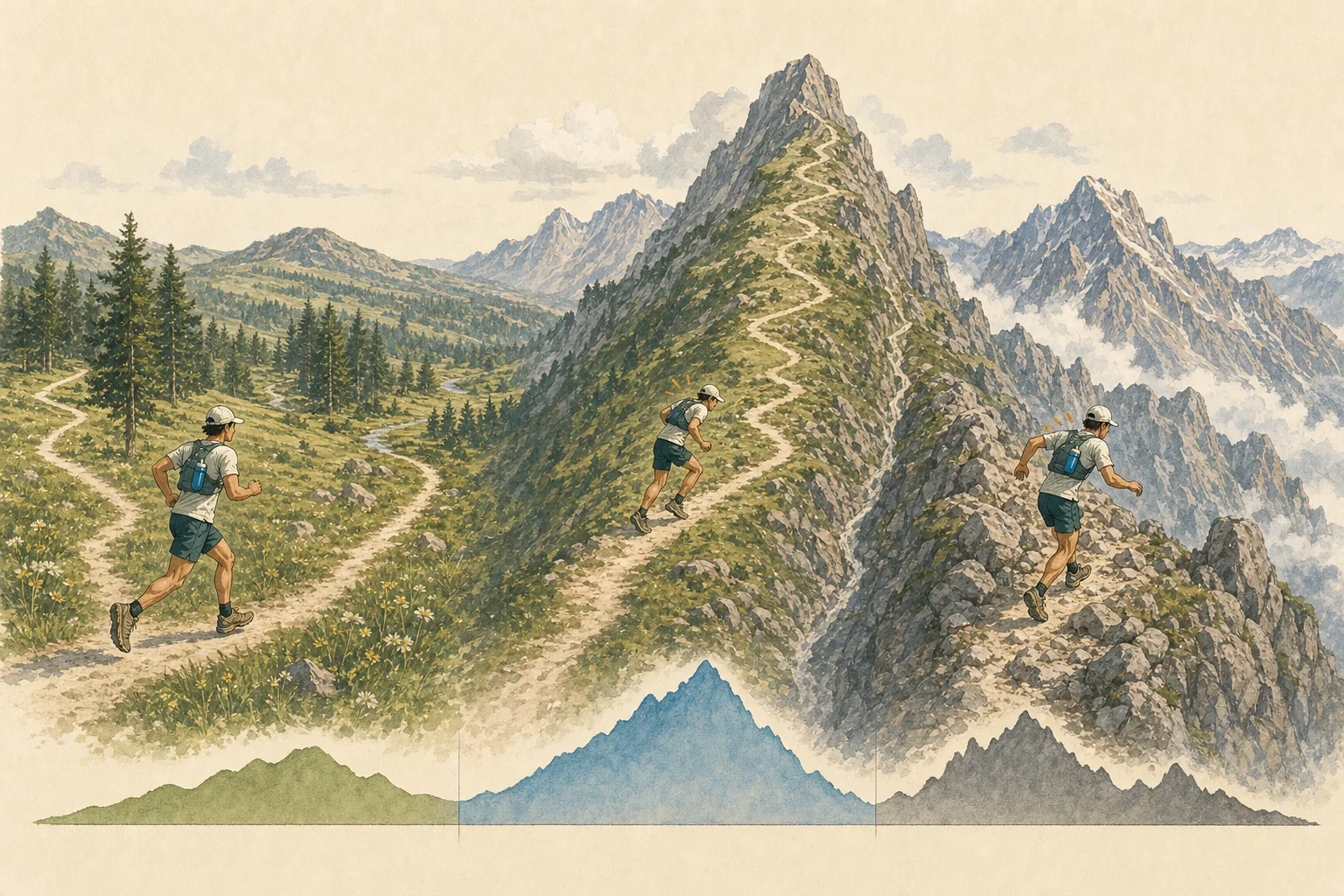
Three trail runners preparing for rolling, mountainous and technical 50K courses with different demands.

Long-distance guide

Prepare for a 50K trail race without copying a generic plan

Learn to read the race, build durable capacity and rehearse race-day constraints. Terrain, expected duration and training history matter more than the number 50.

Scientific revision 1.0 · 31 July 2026

Step 1 — Describe before planning

A 50K is not a unit of training load

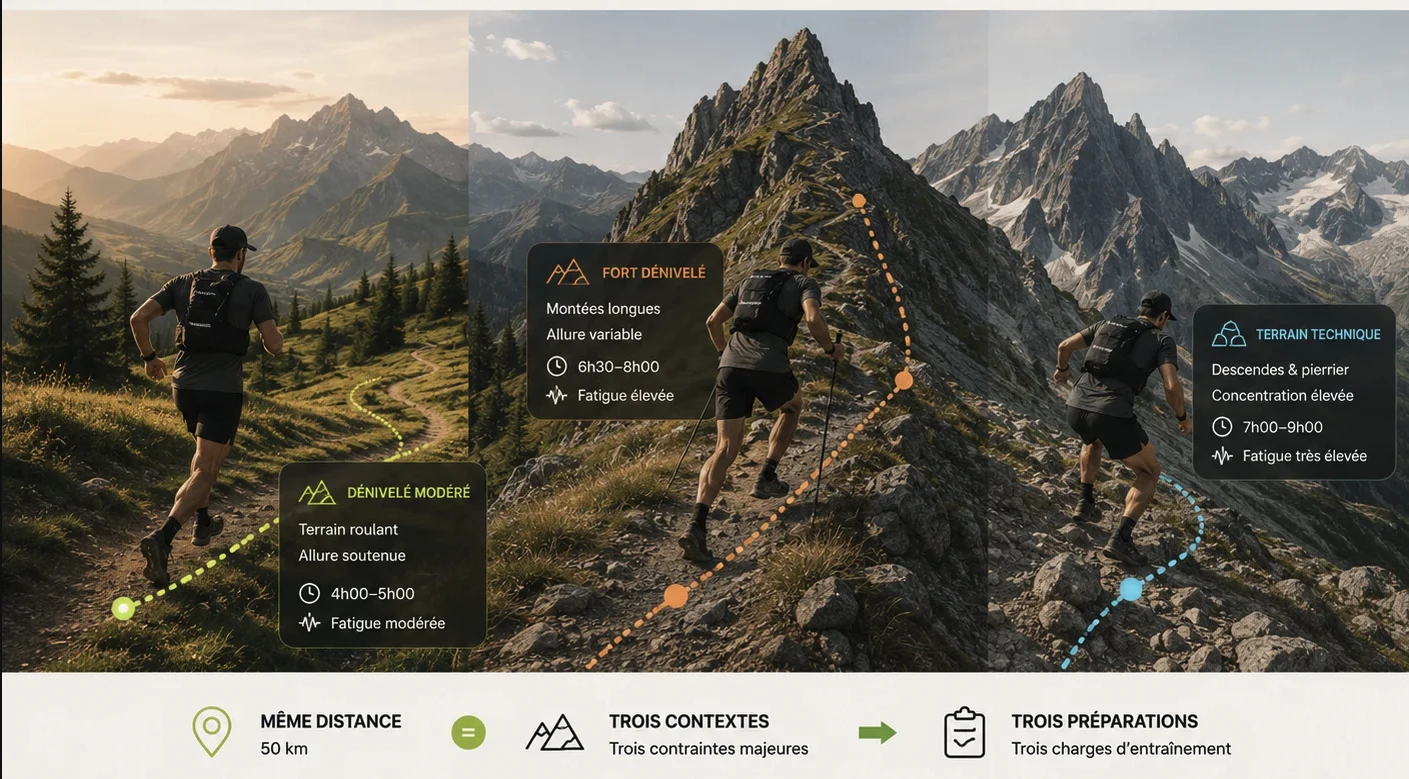
Turn the course into observable constraints before selecting sessions. The same distance can create very different durations and muscular fatigue.

Three illustrated 50K courses: rolling, mountainous with large elevation gain, and technical trail.
Same distance, three different efforts. Elevation, technical terrain, duration and self-sufficiency reshape the preparation.
Expected duration
Time on feet describes exposure better than distance alone.
Elevation and grades
Separate total gain, runnable or hikeable climbs, and the actual amount of descent.
Technical terrain
Rocks, mud, corners and unstable footing add coordination and attention demands.
Self-sufficiency
Aid-station spacing, verified water and mandatory gear change carried mass and strategy.
Environment
Heat, cold, altitude and start time require separate testing when relevant.

Trailboard should keep official course facts, duration estimates and preparation assumptions separate.

Step 2 — Start from the real runner

The same course calls for three different preparations

Choose the closest profile to reveal the block priority. It is neither a permanent level nor a pass/fail test.

You run consistently and have finished shorter trails, but the duration is new.

PriorityBuild tolerable consistency and learn to hike efficiently before greatly extending the long run.

Adapt

  • Increase one main constraint at a time.
  • Repeat stable weeks before loading again.
  • Test food, pack and shoes early.

Step 3 — Progress through decisions

Preparation moves through phases, not mandatory kilometres

This timeline is a decision framework. Each phase depends on history, life constraints and response to previous weeks.

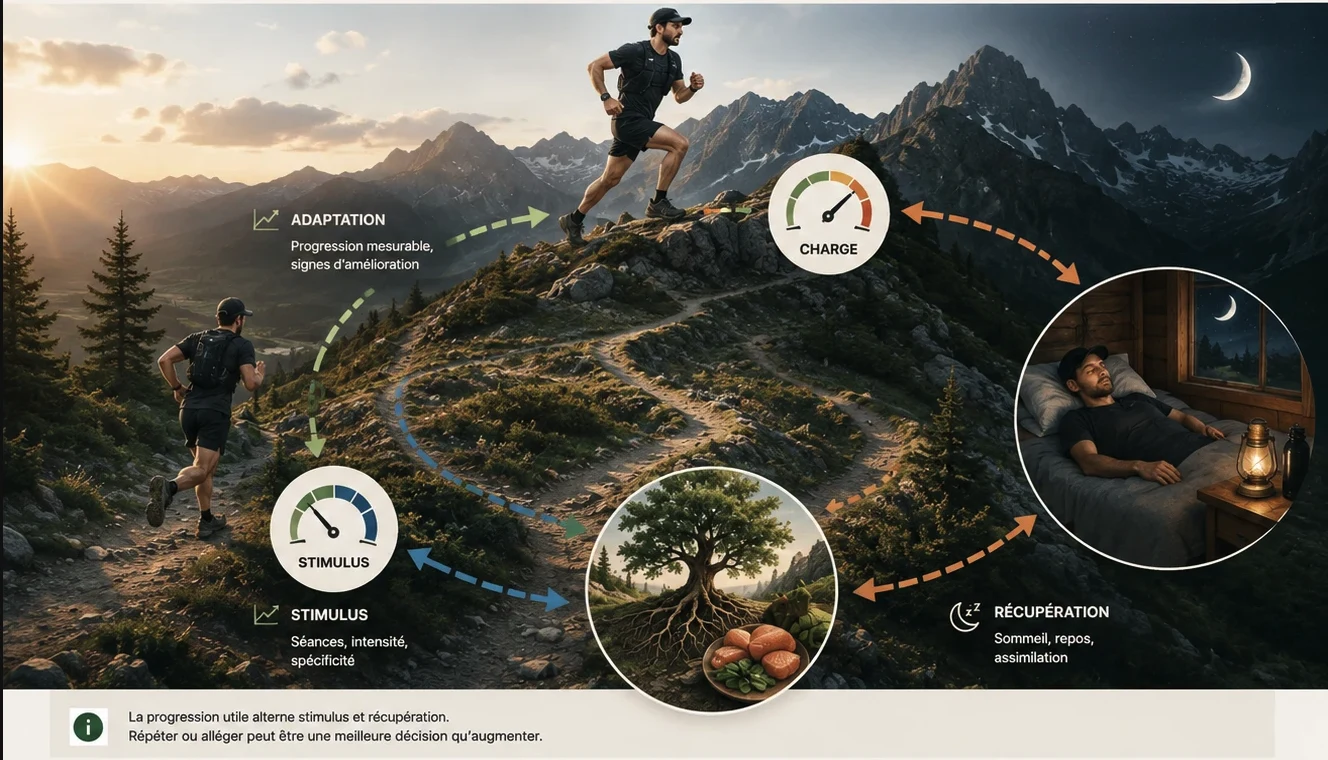
Trail runner progressing through cycles of load, recovery, observation and adaptation rather than climbing continuously.
Useful progression alternates stimulus and recovery. Repeating or reducing may be better than increasing.
  1. 01

    Foundation

    Until consistency is stable

    Sustainable frequency, easy endurance and controlled strength.

    Usual sessions are absorbed without persistent deterioration.
  2. 02

    Build

    Progressive block

    Develop time on feet, climbing and strength without increasing everything together.

    The target load is repeated with predictable recovery.
  3. 03

    Specific

    Several rehearsals

    Reproduce terrain, elevation, descent, pack and nutrition on representative segments.

    The strategy remains usable under fatigue without simulating the full race.
  4. 04

    Taper

    Often 8–14 days

    Reduce fatigue while retaining movement and brief reminders.

    The legs become available again without a sense of detraining.

Stable response

Expected fatigue, normal sleep and motivation, no worsening discomfort.

Repeat or increase one constraint.

Unclear response

Unusual fatigue, morning stiffness or declining quality over several sessions.

Maintain or reduce before drawing conclusions.

Limiting response

Increasing pain, altered function, systemic symptoms or deteriorating recovery.

Stop escalation and seek appropriate advice if it persists.

Frandsen et al. associated large single-session distance increases with more injuries. The study does not validate an automatic individual boundary at 10%.

Step 4 — Choose the right tool

Six session families, six different functions

A useful session solves an identified problem. It is not included merely because a generic plan places it on Tuesday or Sunday.

One trail runner practising uphill hiking, controlled downhill running, endurance and strength training.
Specific capacity combines aerobic fitness, economy, steep hiking, downhill tolerance and strength.
01

Easy endurance

Accumulate aerobic work with fatigue compatible with consistency.

Conversational effort on simple terrain or cross-training according to recovery.
02

Sustained uphill

Develop aerobic capacity, uphill economy and run-hike transitions.

Progressively match grade and interval length to the course.
03

Specific long run

Test time on feet, strategy and durability without reproducing the entire distance.

Prioritise duration, elevation or technical terrain according to the biggest course gap.
04

Progressive downhill

Build skill and tolerance to eccentric muscle actions.

Start short, controlled and less technical; space demanding exposures.
05

Strength training

Improve strength and economy without claiming guaranteed injury prevention.

Build early, maintain later and avoid major novelty near race day.
06

Recovery

Allow adaptation and make the next session productive.

Rest, very easy running or low-impact activity according to signals.

Back-to-back weekends and long run-hikes are possible field tools. Their superiority is not established; they only help when their recovery cost remains acceptable.

Step 5 — Make the strategy usable

The dress rehearsal tests the system, not the ego

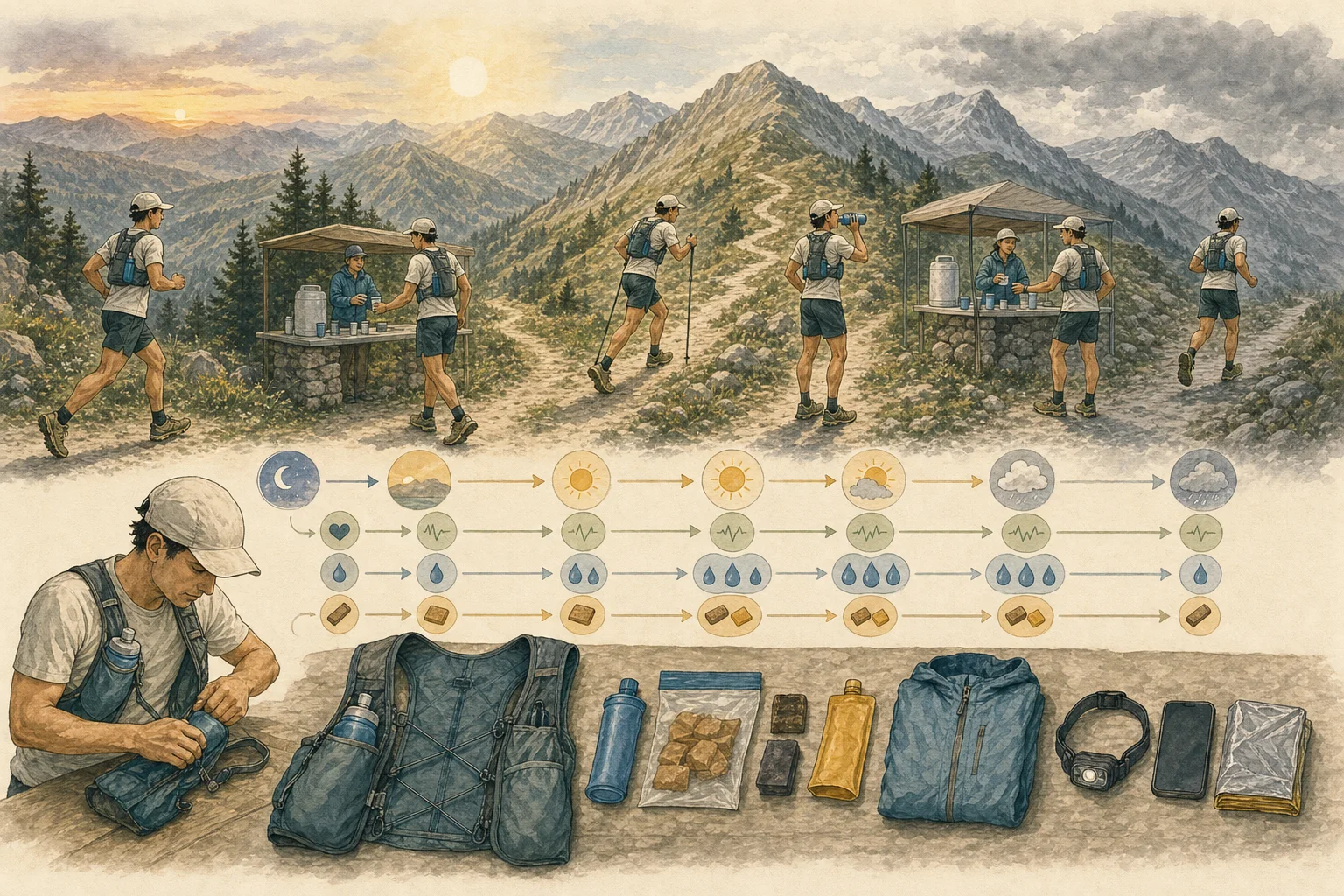
Choose a segment combining the important constraints and execute it with the decisions planned for race day.

  • Pacing and hikingControlled start, uphill hiking threshold and restart after the summit.
  • NutritionProducts actually consumed, tolerated hourly intake and backup option.
  • HydrationActual drinking, weather, verified water access and segment carrying needs.
  • EquipmentLoaded pack, shoes, poles, pocket access and mandatory gear.
  • DecisionsResponses to delay, missing aid, heat or gastrointestinal discomfort.

A successful rehearsal creates information. It does not prove that the race will be easy or justify an immediate load increase.

Trail runner rehearsing a race segment with pack, nutrition, weather, pacing and aid station.
A dress rehearsal tests the complete system on a representative segment, not the full 50 kilometres in training.

Step 6 — Arrive trained and available

Tapering removes fatigue, not all activity

Endurance evidence supports reducing volume while retaining selected reminders. It does not define one 50K trail protocol.

Reduce volume

A progressive reduction is generally more useful than one last large week.

Keep movement

Retain familiar frequency and brief intensity if it already belongs in training.

Remove novelty

No new eccentric session, equipment experiment or heavy strength catch-up.

Individualise

A very fatigued athlete and a lightly loaded athlete do not require the same reduction.

The meta-analysis found a favourable signal around 8–14 days and a 41–60% volume reduction, but studies are not ultra-trail specific and include few women.

References and evidence levels

What is established, observed or simply useful for reasoning

Reviews and consensus statements frame the guide. The Running Clinic resources are used as educational frameworks and do not replace scientific publications.