You finish long trail races but have not yet spent a full day moving in the mountains.
PriorityBuild continuity without rushing load.Build
- Active uphill hiking
- Progressive long runs
- Early nutrition practice
- Observe 48-hour recovery
 TRAILBOARD.
First ultra guide
Moving from long trail races to ultra is not about running 100 kilometres in training. Build and connect five capacities while keeping enough margin to reach the start fresh.
Scientific revision 1.0 · 31 July 2026A new scale
Distance rises, but availability for the real constraints matters as much as preparation. Prolonged exposure and the accumulation of small errors transform the event.
Core rule: prepare the expected duration and course demands, not the full distance in one training run.
Starting point
A profile selects the next useful proof. It is neither permission to race nor a diagnosis.
You finish long trail races but have not yet spent a full day moving in the mountains.
PriorityBuild continuity without rushing load.Architecture
First-ultra preparation often spans several months, but exact timing depends on history, terrain access and recovery.
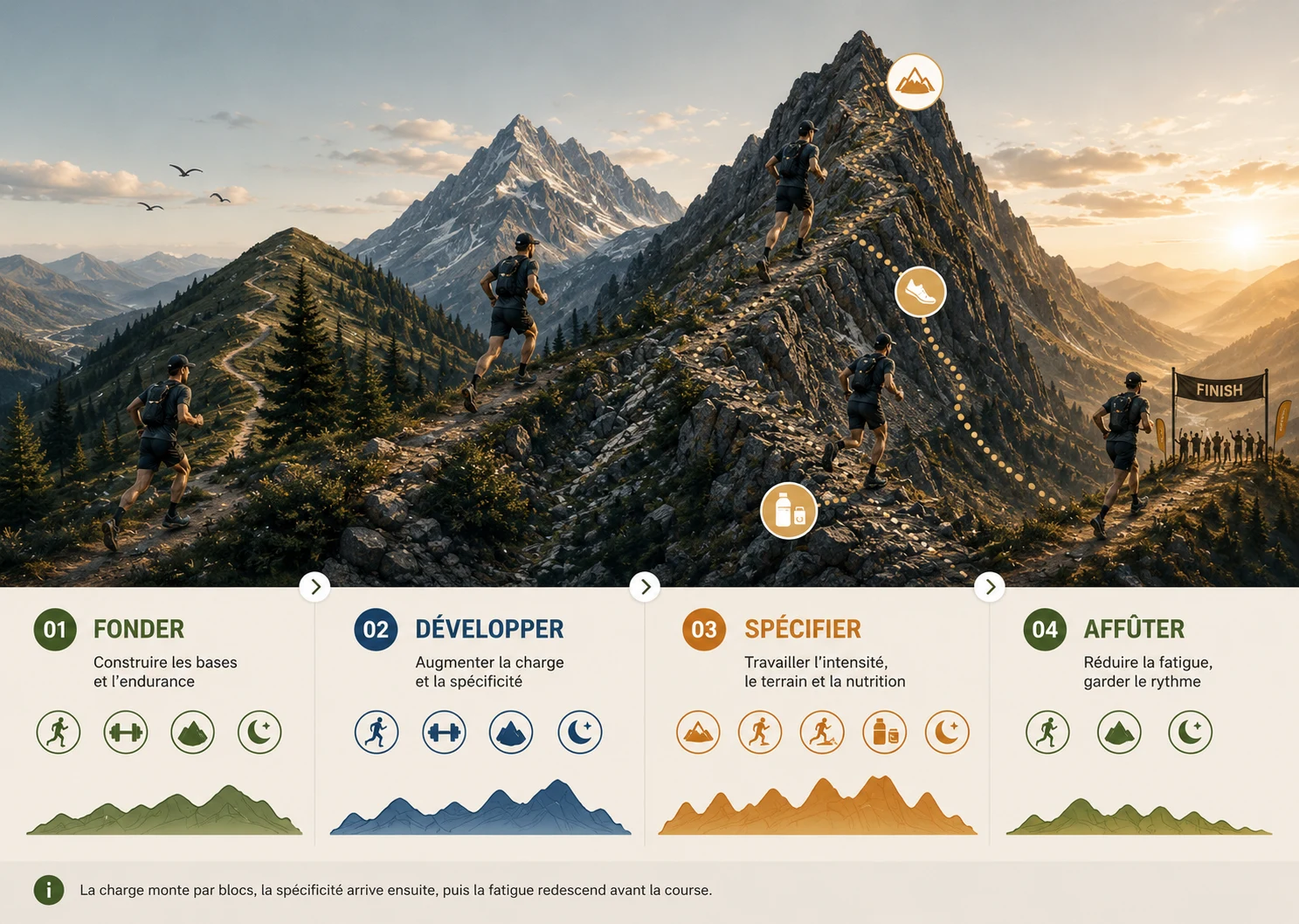
Easy consistency, strength, active hiking and tolerance to frequency.
Weeks connect without increasing pain or fatigue spilling into daily life.Climb, descend and fuel on terrain resembling the race.
Technique and intake stay stable as duration rises.Rehearse the race system without chasing total distance.
Equipment, pace, feet, night and aid routine work together.Reduce fatigue while keeping short familiar reminders.
Readiness and motivation return without feeling detrained.Sleep, mood and legs return close to baseline.
Keep the planned progression.Unusual fatigue, poorer technique or less stable digestion.
Hold or reduce before adding.Growing pain, sustained sleep disruption or clear loss of daily function.
Stop progression and seek appropriate advice.Durations are planning frames. Research does not validate one universal plan or a fixed weekly increase for everyone.
Specificity
They do not all belong in every week. Two demanding constraints are often enough; the rest supports continuity.
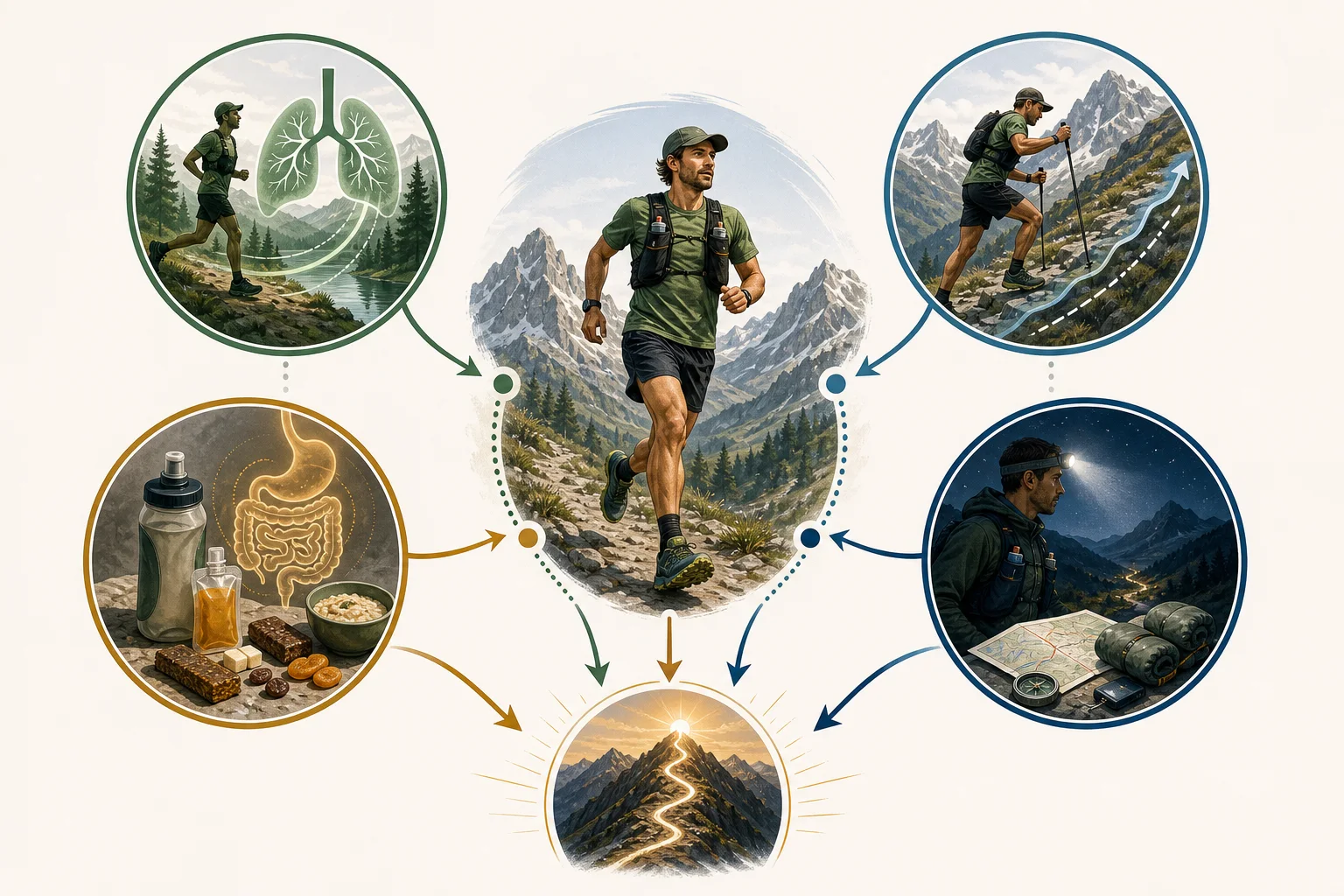
Build frequency and sustainable time without excessive fatigue.
Make run-hike transitions efficient, with or without poles.
Prepare eccentric load, foot placement and technical clarity.
Support economy, force and musculoskeletal tolerance.
Test pacing, carrying, intake, feet and clothing over several hours.
Check lighting, temperature control, alertness and navigation.
Back-to-back days can teach you to restart with residual fatigue, but they are optional and useful only when recovered without a sudden load spike.
Field validation
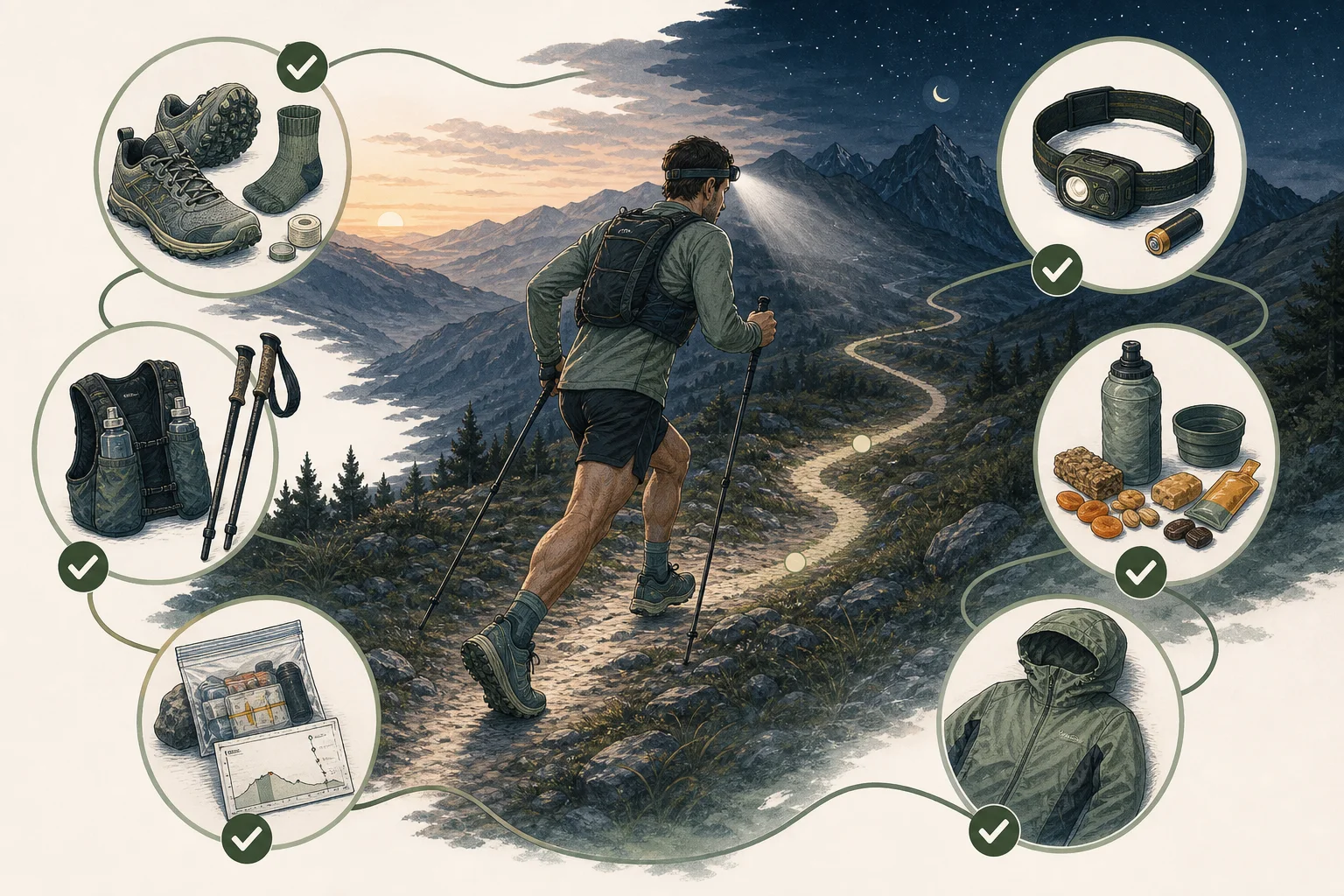
Before race day, verify how the plan’s elements interact during a controlled outing, early enough to absorb it and adjust.
A successful rehearsal creates decisions. If it only proves you can suffer, it is too costly or poorly defined.
Trailboard algorithm
A 100K is not simply an hourly number multiplied by total duration. Trailboard calculates totals, then checks whether every segment, carrying setup and confirmed resource can actually support them.
The plan starts conservatively and progresses only from demonstrated tolerance. Calculations remain separate from their interpretation.
Long-duration baseline: 50–70 g/h without confirmed high tolerance; 60–90 g/h only after training. The upper target is capped by known tolerance + 10 g/h.
The engine compares this volume with carrying capacity. An excess becomes a carrying warning, not an assumption about the next aid station.
Loss is calculable only when sweat rate and sweat sodium are measured. Otherwise the range and its assumptions stay visible.
It is counted over the whole event, never added to “repair” fatigue or an insufficient strategy. Above 6 mg/kg triggers a warning.
Final weeks
Taper progressively lowers volume while keeping some frequency and short athlete-specific stimuli.
Place it early enough to recover; do not try to rescue an incomplete build.
Reduce progressively while retaining short familiar outings.
Keep brief climbing and downhill reminders without major muscle damage.
Finalise pack, batteries, weather, travel and aid plan without late product changes.
Meta-analyses support lower volume while retaining selected stimuli, but accumulated fatigue and individual response guide the final adjustment.
Method
Sources support principles and associations. They do not prove that one mileage or session fits every athlete.
Interdisciplinary framework for physiological, nutritional, biomechanical and psychological limits in ultra-endurance.
↗Association between training history and 100K performance; it does not define a mandatory individual mileage.
↗Review of eccentric downhill demands and adaptations from progressive exposure.
↗Meta-analysis of strength adaptations relevant to distance-running performance.
↗Consensus on load-recovery balance, individualisation and injury risk.
↗Consensus on the possible effects of low energy availability and the need for individual assessment.
↗Quantitative synthesis of taper strategies in endurance athletes.
↗Review of session RPE as a simple tool for estimating internal load without imposing a target value.
↗Reference on ultramarathon-specific nutrition demands and race logistics.
↗Position stand on training nutrition, gut training and ultra race nutrition.
↗Describes sleep strategies and reported consequences of sleep loss in mountain ultras.
↗Maps musculoskeletal injuries reported in ultra-endurance training and racing.
↗Chargement…
Member space
Comments
Share your experience, ask a question or add a useful insight for the community.